

Forming Ordained Ministers with a Synodal Style
Study Group 4's Final Report

Clericalism was frequently identified as one of the most significant obstacles to the full participation of all the faithful in the Church’s mission during the worldwide synodal process that led up to the two assemblies of the Synod on Synodality in 2023 and 2024. For example, the Asian continental document that emerged from this process defined clericalism as “the lack of consultation [by priests] in administrative matters, domineering attitudes and sense of entitlement shown by those in authority especially priests, overextension of power on the people, etc.” (#113). During these national and continental consultations, it was also frequently noted that clericalism is often paired with apathy or passivity on the part of lay people.
Clericalism is less of a central issue in the final document produced by the Synod, For a Synodal Church: Communion, Participation, Mission, perhaps because the latter is more focused on proposing how the Church can become more synodal rather than closely analyzing the obstacles in the way of that goal. Even so, the document called on priests to adopt a “synodal style” of ministry (#72) and recommended that the formation of seminarians should not only instill this “synodal style,” but also that priestly formation itself should in some sense be synodal (#148). For example, it supports what it calls “shared formation,” in which seminarians, priests, lay people, and religious brothers and sisters participate together in spiritual formation opportunities (#143).
Acknowledging that getting into the details of revising the formation of seminarians was beyond the scope of the Synod’s delegates, in March 2024 Pope Francis established a study group dedicated to that topic. This study group was one of ten created by Francis to tackle themes related to the work of the Synod but that required expertise or time for deliberation that was unavailable to the delegates. The interim reports produced by the study groups were published by the Vatican last November, and now their final reports (which were supposedly due to be completed by December 31) are starting to trickle in. the report on priestly formation was one of the first to come in, alongside that on the mission of the Church in the digital environment, on March 3. Interestingly, the report is dated August 28, 2025, although this is likely to be a mistake; the study group’s interim report had the same date, and it suggested that the group would be drafting their final report through November. In other words, we don’t know when the report was actually completed or why it is only being published now.
Study Group 4, had originally been tasked with recommending revisions to the Ratio Fundamentalis Institutionis Sacerdotalis, the Vatican’s guidelines for the formation of seminarians. As they noted in their October 2024 presentation to the Synod delegates, however, they immediately ran into the problem that the Ratio Fundamentalis had already been recently revised in 2016, and many episcopal conferences around the world were still in the process of adapting it to local needs (the United States Conference of Catholic Bishops published the sixth edition of their Program for Priestly Formation in 2022). Pope Francis himself, in an address to the Vatican’s Dicastery for the Clergy given just three months after the study group was established, made it clear that the Ratio Fundamentalis should not be revised. The study group, then, faced a dilemma concerning how to proceed with their work, and relatively early on they decided to draft a preamble that should be added to future printings of the Ratio Fundamentalis which would offer guidelines for the latter’s implementation in light of the Synod’s final document. The study group’s final report is that “Guiding Document,” or at least a draft of it, to be considered by Pope Leo XIV, the General Secretariat of the Synod, the Dicastery for the Clergy, and perhaps others.
Study Group 4’s final report is divided into two main parts. The first essentially offers a theological reflection on what a synodal style of ordained ministry looks like, and the second provides guidelines for the formation of seminarians designed to help foster that pastoral style. In the first section, the report notes an inherent tension in envisioning a synodal style of ordained ministry. If all Christians are called to be missionary disciples in virtue of their baptism, it may seem as if there is a danger that those called to ordained ministry will lose their distinctive identity. In reality, however, it states: “In a wholly synodal Church, animated by charisms and ministries for mission, priests . . . occupy their own specific and unmistakable place.” In fact, bringing “to full flowering the gifts and charisms” of all the faithful allows ordained priests to more faithfully carry out their distinct role:
[I]t actually makes it more authentic and more evangelical and gives it fresh energy and renewed vitality, avoiding burdening priests with duties that do not concern the essential and specific aspects of their ministry and sparing them unnecessary stress.
What are the essential and specific aspects of ordained ministry? The report states that ordained ministers are configured to Christ as “Shepherd and Servant” (a phrase drawn from the Ratio Fundamentalis). Their ministry includes the proclamation of the Word of God and “the presidency of the celebration of the Eucharist.” The carrying out of this ministry, however, ought to be done in a synodal way.
The report explains that “it is not by chance” that the Second Vatican Council’s Dogmatic Constitution on the Church, Lumen Gentium, addresses the nature of the Church as the participation of the faithful in the divine life and as the People of God before considering the hierarchical constitution of the Church. The fact that “all the baptized enjoy equal dignity and are all involved in the common mission” has a certain logical priority over hierarchical roles. Ordained ministry is “‘in and from’ the People of God.” The faithful must, therefore, resist “the temptation to place the priest in isolation and in a sacred aura ‘ahead of’ and ‘above’ the People of God.”
One way that ordained ministers, and especially pastors, can live out their vocation is “to ensure harmony among all and to promote the charisms present in the community in view of the mission [of the Church].” In other words, a pastor should nurture the gifts and vocations of the faithful in their community and ensure that the faithful collaborate and coordinate with one another in carrying out those vocations. Citing the Synod’s final document, the report states:
In this way, it will become more evident that the parish is not centered on itself but oriented towards mission. The parish is then called to sustain the commitment of so many people who in so many ways live and bear witness to their faith in their profession, in social, cultural and political activities.
Another way that ordained ministers ought to exhibit a synodal style is through fostering ecclesial discernment and ensuring that pastoral decision-making is consultative and accountable. A pastor does not engage in discernment on behalf of the community. Rather, the pastor’s role is to encourage all the faithful of the community to participate in ecclesial discernment, identifying goals and the appropriate response to challenges through prayer, reflection on the Word of God, and listening to one another.
The report, again citing the Synod’s final document, also explains that the pastor should foster “as great a participation of all the People of God as possible in decision-making processes.” This does not mean that all the faithful participate in decision-making in the same way; rather, decision-making should embody “differentiated co-responsibility.” Pastors also need to be accountable to the faithful in their leadership and decision-making, offering transparency through reports on the parish’s finances and ministries and ensuring that pastoral workers are treated fairly and that children and other vulnerable groups are protected from abuse.
The second part of the report then explains how this synodal model of pastoral leadership can be fostered through the formation of seminarians. It may be helpful here to recall some of the basic features of this formation, as laid out in the Ratio Fundamentalis. There are four dimensions of formation: 1) human formation, which includes growth in emotional maturity and in the moral virtues; 2) spiritual formation, which involves developing regular participation in the sacraments, especially the Eucharist, an active prayer life (including beginning to pray the Liturgy of the Hours), and a sense of spiritual discernment; 3) intellectual formation, which involves coursework in philosophy, theology, and related subjects like homiletics and apologetics; and 4) pastoral formation, or integrating the other three areas of development with the practical skills needed to carry out pastoral ministry.
Seminarians also progress through four stages of formation, each of which involves ongoing development in the above-mentioned four dimensions of formation: 1) the propaedeutic stage, one to two years in which the seminarian lives in community with others to ensure they have sufficient maturity and a proper vocation to the priesthood; 2) the discipleship stage, in which the seminarian focuses on growth in moral character and in their relationship with Jesus (and during which they primarily study philosophy); 3) the configuration stage, during which the seminarian increasingly envisions themselves in the role of an ordained priest and engages in the advanced study of theology; and 4) the vocational synthesis or pastoral stage, during which the seminarian begins to engage in pastoral ministry under the guidance of a pastor. The seminarian is ordained as a transitional deacon at the beginning of, or early on in, this stage.
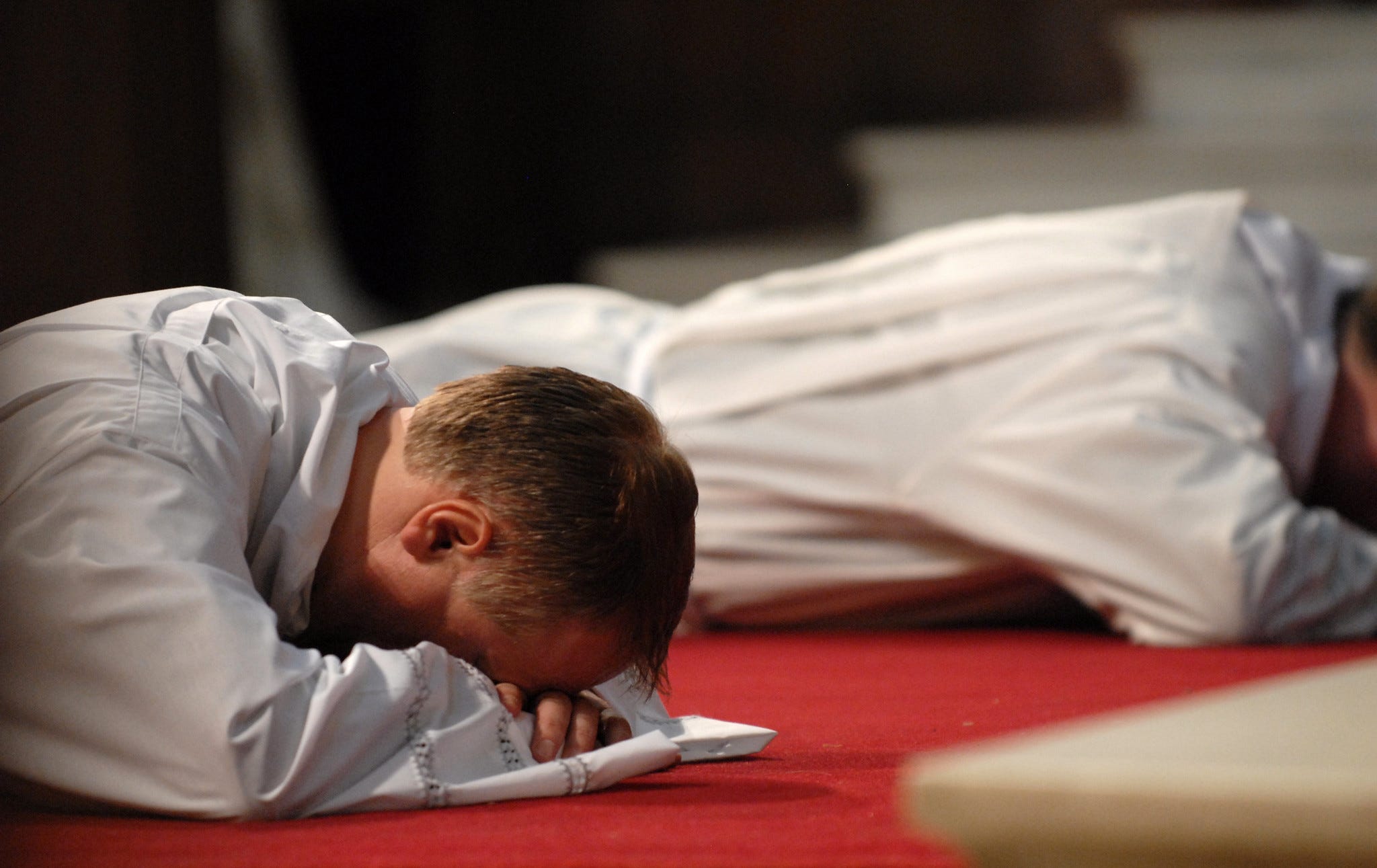
The report acknowledges that fostering a synodal style of ordained ministry touches on all four dimensions of formation. It also must be woven into each of the four stages of formation. Here it’s probably worth making an important clarification. The study group is not at all suggesting that they are introducing a revolutionary change to the formation of seminarians or that they are addressing major flaws in the current Ratio Fundamentalis. On the contrary, they affirm that the current Ratio Fundamentalis is firmly grounded in the teachings of the Second Vatican Council and implicitly reflects the notion of synodality. The study group’s intention is rather to introduce some specific guidelines for priestly formation, in light of the recommendations that emerged from the synodal process and the Synod’s final document, that will strengthen the synodal dimension of that formation.
The report’s second section offers several recommendations for the formation process for seminarians, and I will only highlight some key themes. An appendix to the report also lists some examples from around the world of dioceses that have implemented practices that illustrate some of the report’s recommendations. One question raised in the report is where the formation of seminarians should take place. On the one hand, it clearly states that “[T]he ‘Seminary’, as updated in the post-conciliar period and, more recently, by the Ratio Fundamentalis, remains a valid formative model.” On the other, it recommends that the opportunities for formation outside the seminary community should be expanded. For example, it suggests that seminarians in the configurative stage could spend time residing in parish communities, a practice typically more characteristic of the vocational synthesis stage.
The report also makes important recommendations about who should be involved in the formation of seminarians. For one, it proposes that women should be part of the formation team responsible for the development of seminarians. It mentions that in 2021 the bishops of France mandated that every diocesan seminary should include at least one woman serving on its administrative council. In the United States, it is already relatively common for women to serve on the faculty of seminaries or as coordinators of different aspects of the formation process. Similarly, it recommends that the formation team should include lay people and religious men and women. One of the report’s most interesting recommendations is that lay people should be involved in helping to discern priestly vocations and in assessing candidates to the priesthood. This is particularly true of those who work with the seminarian in parishes and other pastoral settings.
Study Group 4’s report echoes the Synod’s final document in calling for “shared formation” in which seminarians participate in formation opportunities with lay people, priests, and religious brothers and sisters. As an example, it cites a diocese in Spain where twenty-five seminarians and twenty-five youth ministry leaders, including both men and women, participate together in an annual, week-long retreat.
Finally, the report makes some interesting recommendations regarding the intellectual formation of seminarians in light of synodality. For example, it suggests that even in the propaedeutic stage, seminarians should be introduced to the Synod’s final document, and that practices foundational to synodality, like respectful listening and dialogue, should be fostered at that stage. In one seminary in Australia, seminarians study together with other university students on the topic of how “to be integral servant leaders, centered on Christ and guided by the Spirit.” Formation in these foundational practices is not limited to the propaedeutic stage, however. For example, several seminaries in Ghana have worked together to create a week-long workshop on “Synodality and Conversation in the Spirit in the Pastoral Context,” in which seminarians participate prior to their ordination, alongside their formators.
During the discipleship stage, seminarians should be expected to internalize a “relational and dialogical” anthropology through the study of the Bible, philosophy, and the human sciences. And perhaps most interestingly for any readers who are theologians, it recommends that the theological curriculum of seminaries should include a focus on “ecclesiology from a missionary synodal perspective and . . . priestly identity from a relational perspective.” It notes that in Mexico, several diocesan seminaries have incorporated courses on “The Ministry of the Pastor in a Synodal Perspective,” “Ecclesiology and Synodality,” and “Missiology,” among others.
Study Group 4, in my view, did an excellent job with their report. It offers practical suggestions for how seminaries can help form pastoral leaders with a synodal style. Even so, given that the report grounds the identity of the ordained priesthood in the ministry of the Word and the priest’s role in presiding over the liturgy, it would be helpful if the report had more to say about how seminarians are formed to engage in preaching, catechesis, and leading worship. The Synod’s final document has some important things to say about synodality and sacramental worship which could be engaged with here.
My main concern with the report, however, is how it will be implemented. Faced with the dilemma that they could not revise the Ratio Fundamentalis itself, Study Group 4 decided that the best option would be to draft a “Guiding Document” that would be placed in future editions of the Ratio Fundamentalis and which should guide its implementation in dioceses around the world. But what will be the fate of these guidelines in countries like the United States where local implementations of the Ratio Fundamentalis have already been published? And since the Study Group’s document, once it takes its final form, will essentially be a preface to the Ratio Fundamentalis, will it be tempting for those responsible for priestly formation to skip over it?
That concern does not take away from the quality of the document. I think anyone involved with, or who cares about, the formation of future priests should give it a read.
Of Interest…
Last week, I wrote that the ongoing conflict in Iran should be considered an unjust war in light of the Church’s just-war criteria. There have been shifting explanations for the rationale for the US’s involvement in the conflict, but even the most defensible claim, that the conflict is intended to destroy Iran’s missile capabilities and prevent a future attack against US assets in the Middle East, it cannot be considered a just war. As I explained, the just-war tradition has long prohibited “preventive wars” meant to neutralize a future threat. Since then, Cardinal Robert McElroy, the Archbishop of Washington, has also spoken out against the conflict in just-war terms. Perhaps more interestingly, Cardinal Blaise Cupich, the Archbishop of Chicago, suggested that the Trump administration is treating the war like a video game, referencing a video posted on social media by the White House in which footage from military strikes were interspersed with clips from action movies and TV shows. For many years, there have been concerns that warfighting would be treated like a video game because of the growing use of drones, in which remote operators make life and death decisions through a video screen, but Cardinal Cupich is right to warn that this mindset is seeping into the broader culture and the halls of leadership.
Also earlier this month, I offered an analysis of a recent brief filed by the USCCB in the upcoming Supreme Court case over birthright citizenship. The brief argues that if President Donald Trump’s executive order attempting to end birthright citizenship were to be implemented, it would be a violation of the human dignity of the children affected. Since then, the USCCB has published another amicus curiae brief in an immigration-related case before the Supreme Court, in this instance a case involving the practice of “metering,” or refusing entry to asylum seekers who arrive at ports of entry along the US border, requiring them to remain in Mexico as they await a chance to make their asylum claim. Not surprisingly, the USCCB’s attorneys oppose this practice in the brief, arguing that it is a violation of the rights of asylum seekers.
The USCCB also published a letter to members of Congress highlighting the ways that Trump administration immigration policy has violated the right to religious liberty. The letter, signed by Archbishop Alexander Sample of Portland, Oregon, the chair of the USCCB’s Committee for Religious Liberty, and Bishop Brendan Cahill of Victoria, Texas, the chair of the Committee on Migration, particularly focuses on immigration enforcement operations in and around houses of worship and the denial of pastoral services at detention centers. This letter is significant because it reflects the USCCB’s ongoing opposition to the Trump administration’s policies on a number of bases. The question of religious liberty has also emboldened a number of bishops who would not normally be particularly vocal about the immigration issue to speak out.
Coming Soon…
As I mentioned earlier, in addition to the report on the formation of seminarians discussed here, the Vatican has also published the reports of two other study groups, on mission in the digital environment and on women’s leadership in the Church. The latter report is particularly important, but unfortunately it is quite long! I will try to write on it for next week. If the other study group final reports are released soon, I don’t know it will be realistic to write separate articles on each report, especially with everything else going on in the world and the Church, but at the very least I will try to offer some reflections on the remaining reports as a whole.
Excellent summary. Thanks for all your fine work in helping us understand the practical implications of a synodal church in light of these reports.
Thank you for your dedicated work!