

The Just-War Tradition and Preventive War
Early Modern Voices and the Current Conflict in Iran

In a recent interview with Vatican News, the Vatican Secretary of State Cardinal Pietro Parolin suggested that the United States and Israel’s military strikes on Iran could not be morally justified, and instead, “[P]eace and security must be cultivated and pursued through the possibilities offered by diplomacy, especially diplomacy exercised within multilateral bodies, where states have the possibility of resolving conflicts in a bloodless and more just way.” He added that, now that hostilities have begun, the parties should return to the negotiating table: “I hope that the din of weapons will soon cease and that we may return to negotiation.”
Several Catholic writers have likewise applied the traditional just-war criteria to the conflict. For example, the editors at America point out that the Trump administration has provided conflicting rationales for the strikes and that the lack of a clearly defined end or goal for the military operation makes it impossible to justify the means. The Catholic philosopher Edward Feser looks in more detail at each of the possible justifications for the strikes and finds each wanting. At the National Catholic Reporter, theologian Matthew Schmalz raises similar concerns while also faulting President Donald Trump for failing to get congressional authorization for the military strikes.
It seems almost pointless, however, to appeal to the moral principles laid out in the Christian just-war tradition and embodied in international law when the Trump administration has adopted a “might makes right” philosophy in foreign affairs and dismisses the laws of war as “stupid rules of engagement” that get in the way of “maximum lethality.” Just-war reasoning presupposes certain moral commitments (including commitments to peace and the limitation of violence shared with Christian pacifists), and when those commitments are not shared, is there any use in undertaking a rigorous moral analysis of conflict?
The great figures of the Christian just-war tradition, however, remind us that it is precisely when faced with the pointless death and destruction of amoral war that we must insist on the relevance of moral principles. In his 1625 classic The Rights of War and Peace, the Dutch jurist Hugo Grotius appeals to both classical Roman authorities and the Church Fathers Lactantius and Augustine to argue that it is justice that distinguishes legitimate public authority from criminality and prevents the unjust from passing off crime as virtue. The Spanish theologian Luis de Molina, in his De Iustitia et Iure (vol. 1, 1593), writes that if the pursuit of power or national interest was a just cause for war, this would mean “each party to the war would be blameless” in attacking the other in pursuit of their own power, a circumstance he considers absurd. Moral reasoning about war offers a kind of clarity in the midst of the darkness of war.
Rather than offering an in-depth analysis of the ongoing conflict in Iran and repeating what others have already said, I thought it would be better to look to the classic authors of the just-war tradition for some insight into the deeper issues at stake.
America’s editors are certainly right that the shifting rationales given for the military strikes against Iran undermine the Trump administration’s moral credibility. Although seemingly forgotten now, only a few weeks ago President Trump threatened military action against Iran in response to a violent crackdown against protestors in the country. In February, Trump again threatened Iran with military strikes if ongoing negotiations over the country’s nuclear program failed to bear fruit. Since the conflict began on February 28, Trump and administration officials have offered several conflicting rationales for the military strikes: the threat of Iran obtaining nuclear weapons, or even the implausible claim that Iran was “two weeks away” from possessing nuclear weapons (despite the fact that last year President Trump claimed Iran’s nuclear capabilities had been “obliterated”); an “imminent threat” of attack by Iran on the United States or Israel, despite no public evidence of such an immanent attack; and freedom for the Iranian people, among others.
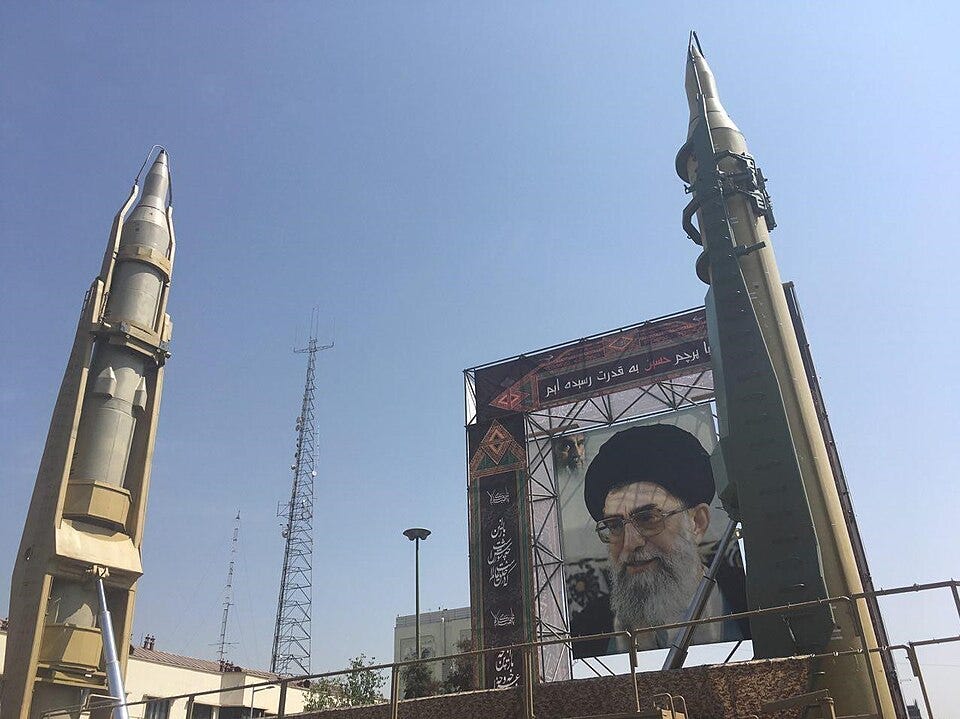
Perhaps the most plausible rationale is the claim that Iran’s ballistic missiles and capacity for building more posed a potential threat to other countries in the Middle East and US troops stationed there. This rationale, alongside the potential threat of Iran’s nuclear program, was cited in the president’s war powers report notifying Congress of the US military’s strikes.
.jpg)
Although obviously early modern just-war thinkers did not have to worry about ballistic missiles, they were quite aware that a political leader could view the growing military capabilities of a rival power as a threat, and therefore see war as a way to neutralize that threat. The sixteenth-century Italian Protestant jurist Alberico Gentili (whom I’ve written about before) wrote at a time when Western European politics was characterized by a struggle between four rival powers: France, England, Spain, and the Holy Roman Empire. Gentili had fled Italy for England due to religious persecution and served as a professor of law at Oxford and a legal adviser to Queen Elizabeth I. In his 1598 work De Jure Belli Libri Tres, he acknowledges that the growing military might of a rival power can be destabilizing and poses a potential threat to other nations. It is not, however, sufficient grounds for a preventive attack against the rising power. Such an attack would only be justified if there is a reasonable fear of an imminent attack.
Grotius also considers this sort of situation, raising the question of whether “the law of nations authorizes one power to commence hostilities against another whose increasing greatness awakens her alarms.” He offers the example of a neighboring country constructing fortifications or strongholds that could plausibly be used to stage an attack at some point in the future. Like Gentili, however, Grotius concludes that such a situation does not justify war; the notion that “the bare probability of some remote, or future annoyance from a neighboring state affords a just ground of hostile aggression, is a doctrine repugnant to every principle of equity.”
Grotius does not minimize the difficult position in which this might place a political leader, since the fact that a threat may be remote rather than imminent doesn’t mean that it’s imaginary. The political leader faces a dilemma between what is expedient for the national interest and what justice demands. He adds: “Such, however, is the condition of human life, that no full security can be enjoyed.” In these situations, Grotius counsels, “The only protection against uncertain fears must be sought, not from violence, but from the divine providence, and defensive precaution.” For example, in the earlier cited case of the neighboring country constructing fortifications or strongholds, Grotius suggests that the reasonable course of action is not an attack, but rather to build fortifications of one’s own.
As I’ve already noted, both Gentili and Grotius acknowledge that the growing might of a rival power can eventually pose a real threat. Gentili shrewdly recognizes that even if a shift in the balance of power or an expanding military is not sufficient to justify a war, when taken together with other factors, there may nevertheless be sufficient grounds for a just war. Someone might argue that is precisely the situation the United States currently faces with Iran. The problem is not just that Iran has increased its ballistic missile capabilities and someday could develop nuclear weapons. Rather, those factors need to be considered together with Iran’s longstanding hostility to both the United States and Israel, its sponsorship of groups like Hamas and Hezbollah, and its responsibility for terrorist attacks in the Middle East and indeed throughout the world.
Although there’s no way to know precisely what Gentili or Grotius would have thought about the current situation in the Middle East, both the drafters of the United Nations Charter and the recent popes have concluded that, given the destructive potential of modern warfare, the resort to war can only be justified in self-defense or in response to a truly imminent attack. A preventive attack against an enemy nation cannot be justified. As Cardinal Parolin explained, diplomacy and the mediation of international institutions are the proper means of dealing with conflict. Tragically, the Israeli and US strikes took place even as negotiations with Iran over their weapons programs were ongoing, with the Foreign Minister of Oman Badr Al Busaidi saying less than a day before the strikes that “the peace deal is within our reach.”
Cardinal Parolin makes a solid case against preventive war that echoes Molina’s argument from more than four hundred years earlier: “If states were to be recognized as having a right to ‘preventive war,’ according to their own criteria and without a supranational legal framework, the whole world would risk being set ablaze.” For example, given the history of US military strikes against Iran, President Trump’s prior calls for regime change, and the buildup of US military presence in the Middle East region leading up to the recent strikes, why wouldn’t Iran have been justified in carrying out preventive attacks against US troops? My point, though, is not that such an attack would have been justified, but that the underlying principle is untenable and indeed risks setting the world ablaze.
As a last note, readers may be wondering why I am relying mostly on the Protestant jurists Gentili and Grotius rather than the Catholic just-war thinkers of the same period, like Francisco Vitoria, Francisco Suarez, and the earlier mentioned Luis de Molina. I am fond of all of them, but when I checked, I found that the Spanish authors do not address the specific question of whether a war against a rising, rival power can be justified. I think it’s likely that they would agree with Gentili and Grotius on the issue since they think a just war must by necessity be a response to the unjust action of another nation. Still, it’s curious that they do not consider this particular question. Is it because they thought the answer was obvious?
But I also wonder whether it is a question of nationality. At the time, the Habsburg dynasty, which ruled both Spain and the Holy Roman Empire, was the dominant power in Europe. Gentili served the English Crown during the English-Spanish War, and Grotius’s entire life was marked by the long struggle for Dutch independence from Spain. Perhaps, then, the Protestant jurists had good reasons to assert the rights of upstart powers against more dominant nations, while the Spanish theologians had a certain blind spot on the issue. Americans certainly ought to be aware of our own blind spots, asserting the right to carry out preventive military strikes around the world against perceived threats without questioning our right to threaten others.
Coming Soon…
Last week, I noted that despite a deadline of December 31, none of the final reports from the ten Synod study groups. Since then, two of the final reports have been published, from the groups on digital culture and seminary formation. I’ll read through these reports soon and evaluate whether I should write on them right away or wait for further reports to be published.
This past week the International Theological Commission published a report on artificial intelligence and transhumanism, “Quo vadis, humanitas? Thinking about Christian anthropology in light of some scenarios for the future of humanity.” The report is not yet translated into English. I’ll wait and see if an English translation is published soon, but if not, I may just jump into the Spanish edition!
Does just war theory apply in a continuous conflict involving several parties in which one or more party's right to exist is at issue? I think you said it when you said "just war reasoning presupposes certain moral commitments." The US commitment seems to be that of an ally, and for that commitment to be moral an in-depth analysis of the Israeli and Palestinian history is necessary. I'm remembering Anwar Sadat, Menachem Begin, and Jimmy Carter.