


The Vatican’s International Theological Commission recently published a document titled “‘Caring for Our Common Home’: A Responsible and Fraternal Response to the Trinitarian God.” Many press reports described the document as an effort to define the concept of a “sin against creation” introduced by Pope Francis in Laudato Si’ (#8) and the similar term “ecological sin” introduced in the final document of the 2019 Amazonian Synod (#82).
This consideration of “ecological sin,” however, although important, makes up only a small part of the document, which is a wide-ranging reflection on the Christian understanding of Creation and humankind’s place in it. The lengthy document (about 3/4 the length of Pope Leo XIV’s Magnifica Humanitas) is divided into three parts focusing on, respectively: a Trinitarian theology of Creation; humankind’s place in and relationship with Creation; and humankind’s responsibility for care of our common home.
The International Theological Commission (ITC) is a body of theologians appointed by the pope that advises the Dicastery for the Doctrine of the Faith. The ITC regularly publishes documents providing expert theological views on issues facing the Catholic Church. Sometimes these documents are linked to important Vatican initiatives or upcoming papal encyclicals: for example, in 2018 the commission published a document on synodality in the Church, and earlier this year it published a document on technology and the future of humanity which foreshadowed some of the themes in Magnifica Humanitas. In other cases, the ITC’s documents address questions of ongoing concern to the Church, such as the 2019 document on religious freedom and a 2009 reflection on the concept of the natural law.
The release of the most recent document was timed to correspond with the opening of the Season of Creation on September 1. Although the Season of Creation (which runs from September 1 to October 4, the Feast of St. Francis of Assisi) was incorporated into the liturgical calendar by Pope Francis in 2015, Pope Leo introduced a new Mass for the Care of Creation last year that is being implemented by many episcopal conferences around the world (including in the United States) this year. The ITC document also comes more than ten years after the publication of Laudato Si’ in 2015. The former covers themes similar to those in the latter, but it is much more focused on unpacking theological ideas that Pope Francis only briefly addresses.
Given the length of the ITC’s document (and the fact that it is currently only available in Italian), I didn’t think it would be realistic to analyze the entire document all at once. Instead, I will cover the document’s three chapters in three separate articles over the next few days. Today, then, I’ll focus on the document’s discussion of the Trinity and Creation.
Piero Corda, the current head of the ITC and the former president of the Sophia University Institute in Italy, a small university affiliated with the Focolare movement, has been a leading promoter of what has been called “Trinitarian ontology.” Trinitarian ontology refers to recent efforts to recover a sense of how the Christian doctrine of the Trinity should inform metaphysics, the philosophical study of being. Those who promote Trinitarian ontology argue that the sharp separation of theology and philosophy has left our understanding of being impoverished when not informed by the Trinitarian view of God, and similarly has made the doctrine of the Trinity seem an appendage to our understanding of the divine nature. Corda’s interest in Trinitarian ontology clearly informs the document, especially the first chapter, although it was drafted by a committee of nine ITC members chaired by Alenka Arko, a professor of theology at the University of Ljubljana in Slovenia.
The document opens with a passage from St. John of the Cross expressing the belief that the created world is “full of the presence of God,” a work of supreme beauty created by a magnificent artist. Since John of the Cross’s time, however, the modern world has experienced three ruptures: a diminished sense of God as the creator of the world; the centering of humankind and our technological mastery of nature; and the current ecological crisis.
The ITC insists that theology (our understanding of God), cosmology (our understanding of the cosmos and the natural environment), and anthropology (our self-understanding as human beings) are interconnected and inform our ecology, our way of relating to the natural world. The purpose of the document is to offer Trinitarian theological reflections on these fields of inquiry to inform Christians’ responses to the three ruptures mentioned previously.
The first chapter, then, offers what one could call a Trinitarian cosmology exploring how the doctrine of the Trinity can inform our understanding of the natural world. It begins by exploring the Trinity’s role in the act of Creation. Creation is, the document insists, “the work of the Triune God.” Although the act of Creation is sometimes attributed to the Father, the Catholic Tradition has long maintained that the work of Creation is in fact the work of the whole Trinity.
Even so, the relations within the Trinity can tell us something about the distinct ways the three Persons carry out the work of Creation ad extra. For example, the Father is the Origin and Cause of all things who sends the Son and Holy Spirit into the world. The Son is the Word of God through whom the Father creates and who’s being is imprinted in the created world. The document appeals to the Eastern Church Father Maximus the Confessor’s notion that the Word, or Logos, encompasses within itself the logoi of created things, the patterns that define them as distinct creatures. The Spirit perfects creation and draws it towards its eschatological fulfillment.
This section gives special attention to the connection between the Incarnation and Creation. It notes that in the Gospel of John, the Word is described as becoming “flesh” (1:14), a term that suggests union with creation in all its materiality. Although Christ took on human nature, there is a “cosmic dimension” to the Incarnation as “the Word in his humanity assumes creation and participates in it.” Appealing to the Apostle Paul’s teaching that through Christ “creation itself would be set free from slavery to corruption” (Rom. 8:21), the ITC likewise insists that through His Passion, Christ redeems all of creation.
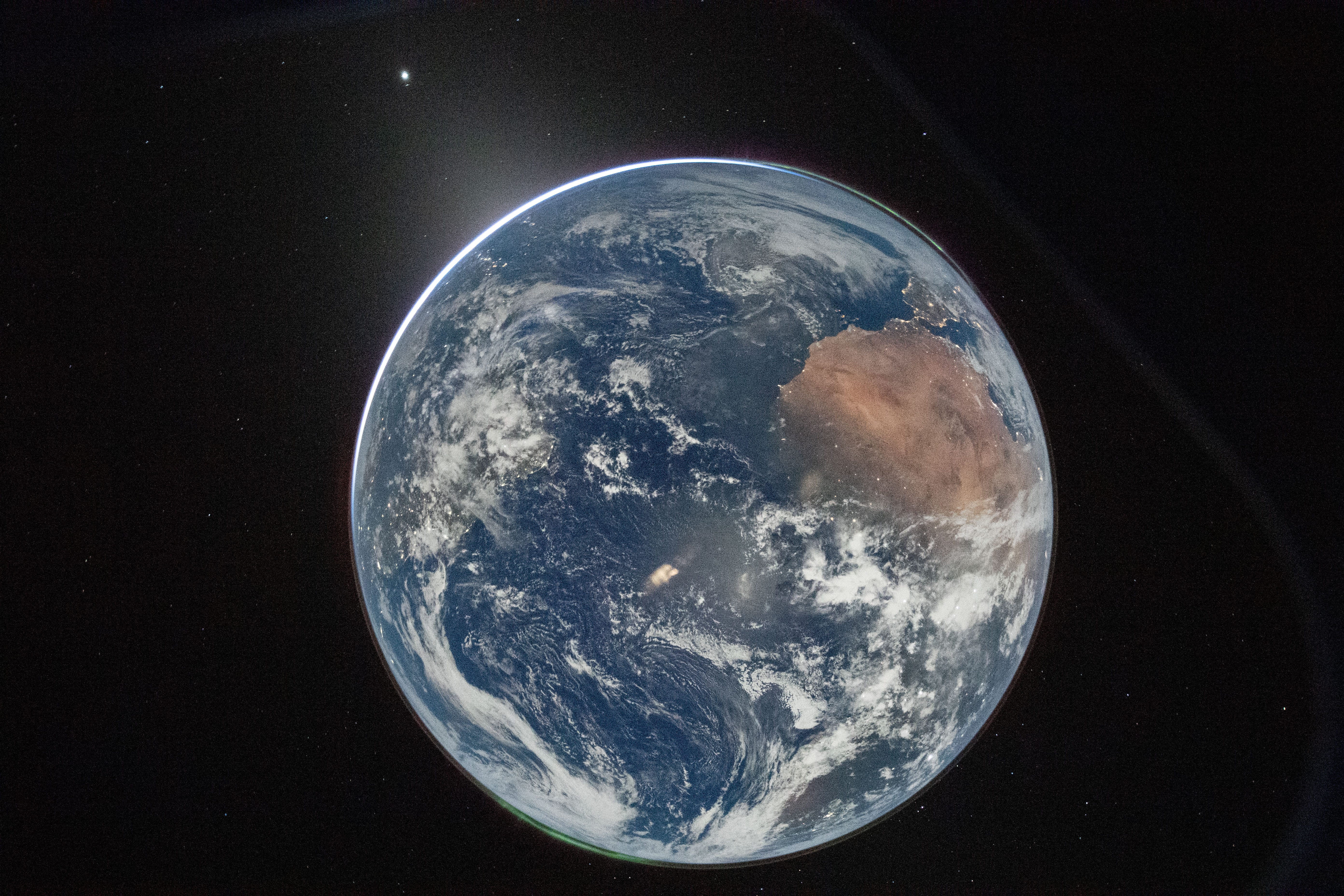

In Laudato Si’, Pope Francis describes how the medieval theologian St. Bonaventure believed that traces of the Trinity could be seen in creation:
For Christians, believing in one God who is Trinitarian communion suggests that the Trinity has left its mark on all creation. Saint Bonaventure went so far as to say that human beings, before sin, were able to see how each creature “testifies that God is three.” The reflection of the Trinity was there to be recognized in nature “when that book was open to man and our eyes had not yet become darkened.” The Franciscan saint teaches us that each creature bears in itself a specifically Trinitarian structure, so real that it could be readily contemplated if only the human gaze were not so partial, dark and fragile. In this way, he points out to us the challenge of trying to read reality in a Trinitarian key. (#239, emphasis in original)
In “Caring for Our Common Home,” the ITC further explores this idea in Bonaventure’s work, as well as in the writings of three other Doctors of the Church: St. Augustine, St. Hildegard of Bingen, and St. Thomas Aquinas.
Although Augustine recognizes that traces of the Trinity can be found in all of creation, his focus is on the human being as the image of God. Augustine famously argues that the Father, Son, and Holy Spirit are reflected in our memory, understanding, and will. The memory is the origin of our thoughts, the understanding helps us penetrate the truth, and the will leads us to love. Hildegard proposes the distinctive notion of viriditas or “greenness,” the vitality of the created world that has its origin in the creative and healing power of the Trinity. And Aquinas offers an explanation of how Creation flows from the relations of the Trinity, such that Creation takes place as a participation in the relationships of love among the three Divine Persons.
Even though the ITC rightly points to the diversity of theological voices in the Tradition who speak to the imprint of the Trinity on Creation, it’s strange that the four examples they marshal all come from the Latin tradition. The introduction to the document rightly points out that as a whole “Caring for Our Common Home” draws on both the Western and Eastern Christian theological traditions in its analysis, but that is sadly not true in this section. The document’s analysis of the four thinkers—and especially Augustine and Bonaventure—also points to a desire to distinguish humankind from the rest of creation as a more complete “image” of the Trinitarian God even while emphasizing the imprint of the Trinity we share with all of creation that will become relevant in the later chapters.
The ITC then goes on to describe in contemporary terms the implications of this Trinitarian ontology for our understanding of the created world. For one, because the universe is created through the Logos, all of creation reflects and finds its final meaning in the mystery of the Incarnate Word. In other words, all of creation has a “sacramental character,” serving as a sign pointing toward its Creator. The sacraments of the Church, then, are the perfection of this sacramental aspect of creation, as created things (the “matter” of the sacraments) become “efficacious signs of the love of God.”
Second, the entire cosmos has an eschatological goal or purpose: union in Christ. Just as everything was created through Christ, all of creation finds its fulfillment in Christ’s ascension and exaltation. Through Christ, creation participates in the life of the Trinity. This fulfillment in Christ is the very purpose of Creation. Here the ITC reflects classic authors like Maximus the Confessor and John of the Cross as well as more recent theologians like Karl Rahner and Hans Urs von Balthasar.
Finally, the Trinitarian ontology developed in the ITC’s document makes clear the relational nature of the created world. Created things are relational by nature, which allows us to say that “everything created is interconnected.” In fact, we might even say (following St. Francis of Assisi) that on our planet, the air, water, plants, animals, and human beings form a single community. Among human beings, this relationality is deepened: we are called to embody the mutual, self-giving love that characterizes the relations of the Trinity. This self-giving love is our distinctive vocation as beings created in the image of God, and we are called to express it in our relationships with God, with one another, and with other creatures. The loss of this truth has contributed to the contemporary world’s interconnected ecological, social, and religious crises.
The opening chapter of “Caring for Our Common Home” closes by affirming that this Trinitarian perspective on Creation needs to be open to dialogue with contemporary science and with other cosmologies. The document identifies three scientific paradigm shifts as particularly important areas for dialogue. First, it points to the Big Bang theory, the leading account of the universe’s origins, and theories of the universe’s slow evolution and increasing complexity over billions of years. Second, it explains the discovery of the atom and later even smaller, sub-atomic particles like neutrinos, alpha and beta particles, quarks, hadrons and dark matter, as well as the development of quantum mechanics. Finally, it states that the discovery of biological evolution, including the evolution of the human species, has revolutionized our understanding of humankind’s place in the cosmos.
Rather than openly exploring the theological implications of these scientific discoveries, the ITC settles for laying out some ground rules for dialogue. For one, both science and theology should exercise epistemological humility, acknowledging that there are multiple sources of knowledge. In this way, the dangers of scientific reductionism and religious fundamentalism can be avoided. The document also warns against what it calls “concordism,” or overly simplistic attempts to reconcile faith and science that downplay the complexity of the questions involved. The ITC’s conclusions here will not be surprising to anyone at all aware of efforts to bring science and religion into dialogue over the past few decades.
The document then briefly considers different philosophical or religious cosmologies: immanentism, pantheism, panentheism, deism, and supernaturalism. What it means by “immanentism” is the complete denial of the existence of a transcendent God or of any higher purpose for the universe. Although immanentism can be atheistic, the ITC seems to consider pantheism—the identification of the cosmos as itself divine—as a form of immanentism.
The ITC distinguishes pantheism from pantheism by defining the latter as the belief that the universe exists in God while God also transcends the world. Panentheists often argue that what they label “classical theism” too sharply distinguishes God and creation, while panentheism emphasizes God’s closeness to creation while maintaining God’s transcendence. The ITC’s reference of panentheism here is significant because many theologians attempting to develop an ecologically aware theology have embraced different forms of panentheism, including the Protestant theologian Sallie McFague and the Catholic Ilia Delio, OSF (although Delio has more recently moved away from the term “panentheism,” which presents a too static view of God and the cosmos).
Deism is the view that God created the universe but otherwise remains disinterested or uninvolved in the world. What the ITC means by “supernaturalism” is the view held by many religious believers, including Christians, that God is external to the world and yet, contrary to deism, is involved with the world. This involvement, however, takes the form of miraculous “interventions.” I critiqued this worldview here, comparing it to the image of God as a puppeteer.
The ITC does not further engage with these worldviews, unfortunately in my view. A dialogue with at least some of these worldviews and their implications for care for our common home would make an interesting document. Instead, the ITC document turns to three areas where the Trinitarian outlook described in the third chapter can engage with modern science and the alternative worldviews just described. For one, the doctrine of creatio ex nihilo presents a God who is intimately involved with creation but distinct from it. The doctrine is compatible with the Big Bang theory and other scientific hypotheses but does not depend on them.
Second, although biological science and anthropology can offer us insights into the chain of causes that led to the emergence of homo sapiens, the sciences do not fully satisfy the amazement aroused by our existence or our quest for meaning. The existence of human beings, the ITC insists, also leads us to explore the question of the meaning of the existence of the cosmos.
Finally, human self-consciousness and freedom pose fundamental questions. Although science can offer explanations for these phenomena that suggest that they are completely determined by biological, chemical, or physical factors, these explanations fail to completely satisfy. Interestingly, the ITC suggests that further research into self-consciousness in other animals, especially primates, can help us understand humankind’s relationship with other organisms but also our distinctiveness.
These last sections of the first chapter of “Caring for Our Common Home” are a bit unsatisfying or incomplete, but its attempt to develop a Trinitarian cosmology is provocative and insightful. The discussion of the Trinitarian imprint on the cosmos and the need for dialogue with contemporary science and other cosmologies also sets up the discussion of humankind’s relationship with creation and the question of “ecological sin” discussed in the second chapter. I’ll analyze that chapter and the final one on our responsibility to care for creation in two upcoming articles.
I wonder about incorporating some of J.R.R. Tolkien's work, especially the Silmarillion and related material. Specifically the "Secret Fire", the power or presence of God that grants reality and life to creation, and personhood to humans, Elves, and other beings. Tolkien identified the "Secret Fire" (also known as the Flame Imperishable) with the Holy Spirit.
See also Stratford Caldecott's book on this topic, and the references to "life" ("zoe") in John's Gospel, and the Nicene Creed.