

The Phantom Heresy: Does It Yet Live?
Who Are the Americanists?

In an earlier post, I noted that some commentators have argued that Pope Leo XIV’s recent conflicts with the Trump administration, particularly over immigration and the war in Iran, represent a recapitulation of the condemnation of “Americanism” by Pope Leo’s namesake Pope Leo XIII, who led the Catholic Church at the end of the nineteenth century and the dawn of the twentieth. In this view, President Trump’s “America First” ideology, at least as it has been adopted by some US Catholics, reflects some of the same tendencies identified by Pope Leo XIII in his 1899 encyclical Testem Benevolentiae.
I insisted, however, that while there is some truth in this claim, the historical reality is more complicated. For one, those late nineteenth-century US Catholics who identified as “Americanists” championed the United States’ democratic institutions, supported religious liberty, and promoted organized labor and economic justice, leading some contemporary writers to look to the Americanists as inspiration for today’s anti-Trump Catholics. At the same time, however, the Americanists did not recognize the value of the cultural diversity within the US Catholic Church and advocated for the rapid assimilation of Catholic immigrants to what we today might call “Anglo-American” culture. And at least some supported American imperialism abroad, particularly during the Spanish-American War.
To be fair—as I noted in the earlier article—I have not yet touched on exactly what Pope Leo XIII condemned in Testem Benevolentiae, what he described as the heresy of Americanism. The heresy of Americanism condemned by Leo should not be equated with those US Catholics who identified as, or were labeled as, Americanists, even if the two are not unrelated. This adds an extra layer of complexity to our attempts to discern the relevance of the Americanist controversy to our own times and to Pope Leo XIV’s pontificate. What we now refer to as the “Americanist controversy” in fact had more to do with how the ideas of the Americanists were received in Europe, and particularly France, than with what they themselves espoused.
In France in the 1890s, a minority of Catholics called for the active participation of the faithful in the secular Third French Republic, a movement known as ralliement. The majority of French Catholics—including the bishops—continued to hold out hope for the restoration of the monarchy, but the supporters of ralliement argued that this simply marginalized Catholics from public life. Pope Leo XIII himself advocated for the ralliement cause in his 1892 encyclical Au milieu des sollicitudes, but this had little impact on the attitudes of the majority of French Catholics.
The French supporters of ralliement saw the Americanists as allies who represented the sort of Catholic religious spirit that was needed in France. They invited Archbishop John Ireland of St. Paul, Cardinal James Gibbons of Baltimore, and Bishop John Keane of Richmond, later the first rector of the Catholic University of America (all of whom I introduced in the previous article), to visit France and advocate for their ideas, and the writings of the Americanists were translated into French. The Americanists also traveled to Rome to advocate for their positions. Gibbons had famously argued in favor of religious freedom in the Vatican on the same 1887 voyage where he defended the Knights of Labor.
In 1895, however, Pope Leo issued the encyclical Longinqua Oceani, written specifically to the bishops of the United States, which condemned the Americanist position on religious liberty. Leo recognized how the laws of the United States had protected the Catholic Church and allowed it to flourish, but he denied that the situation in the United States represented “the most desirable status of the Church” throughout the world. Instead, the Church “would bring forth more abundant fruits if, in addition to liberty, she enjoyed the favor of the laws and the patronage of the public authority” (#6). This was a significant blow to the Americanists and a victory for their conservative opponents. The Americanists would not be vindicated on this issue until 1965, with the promulgation of the Second Vatican Council’s Declaration on Religious Freedom, Dignitatis Humanae.
Back in France, in 1897 the Comtesse de Ravilliax published a translation of Life of Isaac Hecker, a biography of the American founder of the Paulists written in 1891 by Walter Elliott, a friend of Hecker’s and himself a Paulist. The preface to the 1897 French edition was written by the theologian Abbé Félix Klein, who proposed that Hecker’s thought represented the dawning of a new, modern Catholic spirituality focused on the active life that would transform the Catholic Church. Klein’s preface generated concern in European Catholic circles, including at the Vatican. The French theologian Charles Maignen authored a series of articles in the journal La Vérité arguing that Hecker (as interpreted by Klein) represented an “Americanist” heresy that synthesized certain Protestant ideas and a “neo-Pelagian” emphasis on the natural virtues over the supernatural virtues. Maignen collected his articles into a book which received its imprimatur from the Master of the Sacred Palace (i.e., the papal theologian), the Dominican Alberto Lepidi. Similar criticisms of Hecker were published by the Jesuits in La Civiltà Cattolica.
At the beginning of Testem Benevolentiae, Pope Leo XIII acknowledges that Elliott’s biography of Hecker “has excited not a little controversy,” and his condemnation of Americanism is clearly based on Maignen’s account. Notably, however, Leo describes his condemnation as a warning about certain ideas without claiming that anyone in particular holds them. In Testem Benevolentiae, Pope Leo characterizes “Americanism” in terms of five beliefs or tendencies:
The belief that it is opportune to omit or downplay certain doctrines to make the faith more attractive to modern people;
The belief that religious freedom as it exists in the civil realm should be applied within the Church, as well, so that the faithful could simply believe as they please;
The belief that the Christian life involves following the promptings of the Holy Spirit with no regard for any external ecclesial authorities;
Opposition to religious vows as an unjust restriction on freedom, and therefore opposition to religious life and religious orders;
A tendency to favor the active life and the natural virtues over the “passive” life of contemplation and the supernatural virtues.
These tendencies are referred to as “Americanism” because they supposedly reflect a synthesis of Catholicism with the American spirit by those who “would have the Church in America to be different from what it is in the rest of the world.” Pope Leo was possibly concerned not just with doctrinal deviations but also a jurisdictional crisis akin to Gallicanism. Pope Leo also warns against the belief that American Catholicism is ushering in a new age that will transform the Catholic Church worldwide. Importantly, Leo is clear that he is not condemning the adaptation of the faith to “certain endowments of mind which belong to the American people, just as other characteristics belong to various other nations,” because the Catholic faith is able to “accommodate itself to the exigencies of various times and places.”
Americanism is sometimes described as a “phantom heresy” because it is based on a critical misrepresentation of a set of ideas that were themselves an exaggerated presentation of Hecker’s thought. The Americanism condemned by Pope Leo XIII cannot simply be identified with the Americanism of Ireland, Gibbons, Keane, and others. Even so, there are certain small kernels of truth in Leo’s condemnations. For example, Ireland was critical of the conservative influence of European-dominated religious orders like the Jesuits in the United States, but that is a far cry from rejecting religious vows on principle! More importantly, some Americanists advocated for a more active, dynamic spiritual life in contrast to what they perceived as rote, passive ritualism, but Maignen was wrong to construe this as downplaying the supernatural virtues of faith, hope, and love.
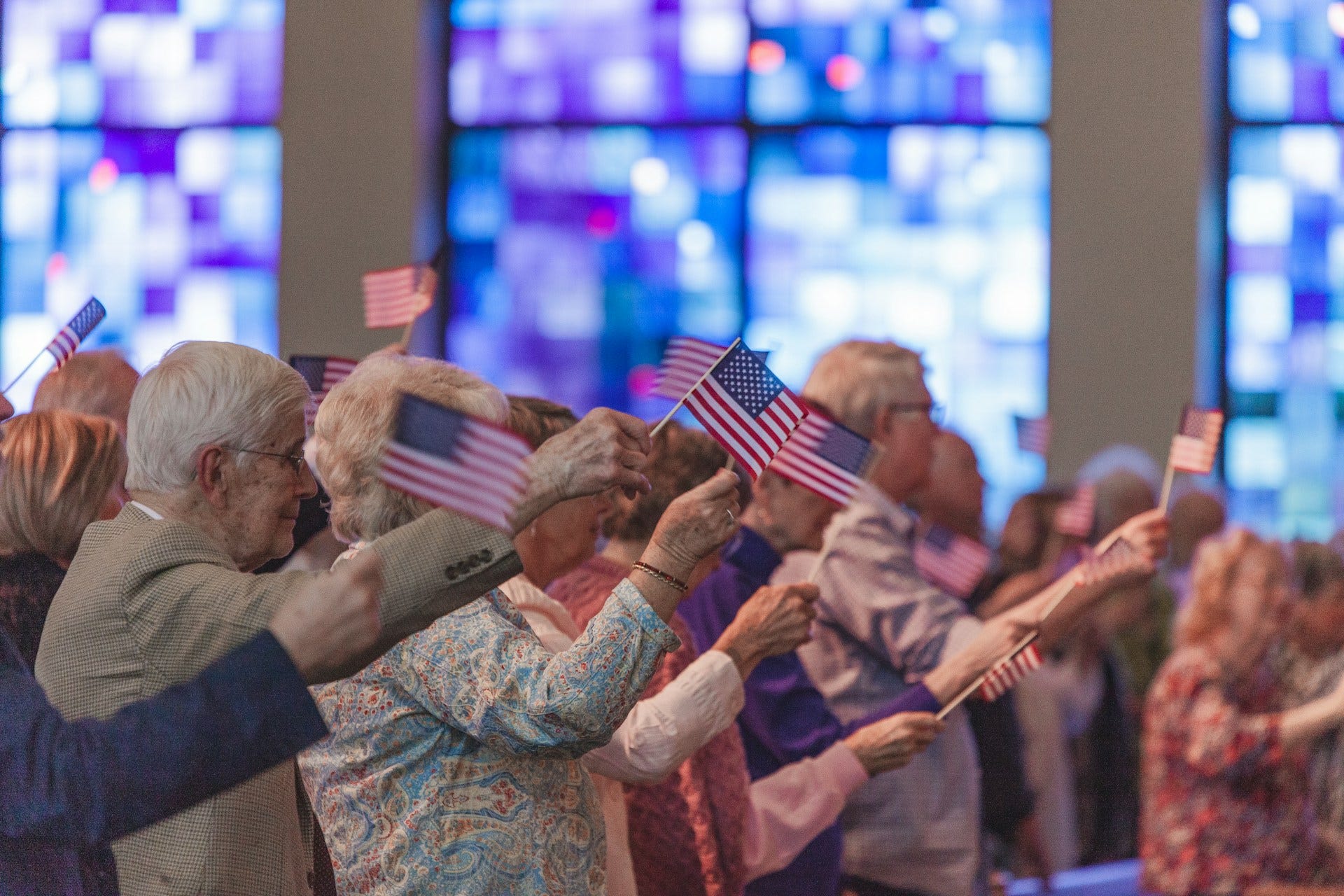
Although very few Catholics have held to the Americanist heresy as defined by Pope Leo XIII’s five principles, one might make the case that what Leo describes as “Americanism” reflects certain underlying tendencies that have been much more widespread. These tendencies might include: a kind of spiritual individualism more characteristic of certain types of American Protestantism; an overemphasis on pragmatism, worldly success or activism, and a “pull yourself up by your bootstraps” mentality, all characteristic of American culture; and a form of American exceptionalism that gives the United States a central role in divine providence.
The twentieth-century American Jesuit theologian John Courtney Murray faced accusations of “Americanism” for his defense of religious liberty. Partly based on the US experience, Murray argued for the development of Catholic teaching in support of religious freedom as not simply an accommodation with political reality but as a human right. Although he faced censure for his writings, Murray later played a key role in drafting Dignitatis Humanae at the Second Vatican Council. The American Catholic experience ended up transforming the worldwide Church, after all.
An intriguing case is that of Michael Novak, an important exponent of a Catholic defense of capitalism. Echoing Murray, Novak argued that the American experience of “democratic capitalism” is an important contribution to the Catholic Church’s patrimony. More interestingly, Novak frequently advocated for the practical virtues of capitalism like creativity, efficiency, pragmatism, and the work ethic, which he believed were frequently downplayed in Catholic social thought. Likewise, Novak claimed that Catholic hostility to capitalism is often driven by a failure to recognize the impact of sin and the impossibility of embodying the Christian virtues in their fullness in economic life. The late theologian David L. Schindler has criticized Novak for what the former perceived as an overemphasis on creativity, neglecting our receptivity of the gifts of being and grace. These disputes closely parallel the earlier controversies over the natural and supernatural virtues, and the active and passive spiritual life.
That being said, one could make the case that Pope John Paul II’s 1991 social encyclical Centesimus Annus takes a more positive stance toward the free market than earlier magisterial documents and demonstrates that the Vatican had learned from the experience of American capitalism, although by no means embracing it. I sift through these issues in more detail in my book Interrupting Capitalism. What’s important here is that in the century plus since Pope Leo XIII published Testem Benevolentiae, the US Catholic Church has significantly impacted the global Church, although we might distinguish that from the sort of rupture in the Church’s Tradition that Pope Leo feared.
Significantly, church historian Massimo Faggioli has recently argued that Pope Leo XIV’s pontificate is characterized by what Faggioli calls “Catholic Americanness.” He writes that, for Pope Leo, “in the foundations of the American project there is an element of catholicity in the sense of universality.” As Sarah Carter notes in her commentary on Pope Leo’s speech accepting the Liberty Medal awarded by the National Constitution Center, the pontiff used the occasion to expound on the compatibility of the United States’ founding ideals and the Christian worldview. As Leo stated:
From our youth, most of us have admired the eloquence of [the Declaration of Independence], with [its] resounding appeal to the law of nature and to nature’s God as the basis of their assertion that all men and women are created equal and endowed by their Creator with certain inalienable rights, including the right to life, liberty and the pursuit of happiness. While couched in the language of the Enlightenment, that claim is ultimately grounded in an understanding of the human person inspired by the great biblical vision of man and woman being created in the divine image. It is indeed here that we discover the basis of human dignity; dignity which precedes the establishment of any State, and whose custody constitutes its very purpose.
It seems clear that with Pope Leo XIV, we can identify a certain “Catholic Americanness” that is distinct from “Americanism.”
Returning to our primary questions, what relevance does the Americanist controversy have today, and does it make sense to say that Pope Leo XIV is responding in his own way to a contemporary form of “Americanism”? As I mentioned in my previous article on Americanism, author Michael Fox and journalist David Gibson have recently argued that what Fox calls “MAGA Catholicism” represents a new manifestation of Americanism (for the sake of convenience, I will use Fox’s term “MAGA Catholicism” throughout to describe those US Catholics sympathetic to President Trump’s “America First” ideology) . And yet contemporary MAGA Catholicism is quite different from the Catholic vision of John Courtney Murray or Michael Novak (although Novak, just weeks before his death in early 2017, did praise President Trump’s 2016 election, calling it “a work of Divine Providence”!), and many MAGA Catholics would identify more with conservative, traditionalist, or “postliberal” tendencies in contemporary Catholicism than with the progressive elements of the nineteenth-century Americanist movement. Even so, both Fox and Gibson make penetrating points.
Fox, for example, makes the case that MAGA Catholics’ emphasis on values such as “enterprise, national sovereignty, market initiative, and military strength” and apparent disdain for the preferential option for the poor, the commitment to welcome the stranger, and the virtue of mercy echo the mindset condemned by Pope Leo XIII. Fox also points to many US Catholics’ tendency to pick and choose when to acknowledge the authority of the pope, allowing what Fox calls “American individualist culture” to be the norm (although to be fair this latter tendency is by no means limited to MAGA Catholics!). Gibson likewise describes how the influence of individualism and nationalism is creating distance between US Catholics and the global Church, one of the outcomes the earlier Pope Leo most feared when he condemned Americanism.
Keeping in mind the differences in historical and ecclesial context and the more progressive elements of nineteenth-century Americanism, I think it would be a mistake to simply identify contemporary MAGA Catholicism as a manifestation of the heresy of Americanism. On the other hand, Fox and Gibson are right to identify certain tendencies of Americanism present today, although I would add that the presence of those tendencies is not at all limited to MAGA Catholicism.
And what of Pope Leo XIV? On the one hand, his stances on the immigration issue and on the war in Iran (and war more generally) which have brought him into conflict with the Trump administration reflect longstanding Catholic teaching that predates Trump’s election by decades. It would be hard to make the case that they represent a response to a distinct phenomenon that could be identified as “Americanism.”
On the other hand, one cannot escape the fact that Pope Leo was elected as the first American pope at a time when the United States, guided by Trump’s America First ideology, is, in Faggioli’s words, “still central [to global politics] but has become the primary source of instability.” Pope Leo has not hesitated to challenge the Trump administration’s policies in light of Catholic teaching, but one could also make the case that his criticisms are also an appeal to American ideals. As Pope Leo stated in his speech accepting the Liberty Medal:
In these past two-hundred and fifty years, for so many peoples throughout the world, it was the firm resolve to achieve the noble vision of the nation’s founders that made America a byword for freedom, as the country opened its doors to successive waves of immigrants, enabling them and their children to play their part in shaping the future of the nation. It was this same love of freedom that inspired the United States, in the darkest hours of the last century, at the time of the two world wars, to look beyond itself and, at great sacrifice, to champion the cause of freedom beyond its own borders.
Here Pope Leo subtly challenges America First foreign policy—based on the will to power and narrow national interest—and harsh immigration policies as a betrayal of the United States’ noblest ideals (which, admittedly, the nation has not always lived up to). The pope’s criticisms, although ultimately grounded in Catholic doctrine, are not foreign to the American spirit but rather are intended to call us to “the better angels of our nature,” to quote Abraham Lincoln’s first inaugural address.
The question of whether MAGA Catholics are “Americanists” is obviously complex, and in the end perhaps not the most pertinent question. Perhaps Pope Leo XIV is calling us to instead reflect on the contrasting visions of “Catholic Americanness” facing us: one in which our distinctive American identity calls us to respect the dignity of all people, welcome the stranger, and serve those in need, and another that leads us to seek to dominate others, to close our borders, and to become estranged from the rest of the Church.
Coming Soon…
Apologies again for running behind on this article. My travels last week went longer than expected, and so I am running behind. I should be back on schedule this week, so stay tuned!
Father Hyacinthe Loyson is probably no longer well enough known to be named without introduction, so it may be worth beginning there.
Born Charles Jean Marie Loyson in 1827, he became famous in France as Père Hyacinthe, a Carmelite preacher whose sermons at Notre-Dame made him, under the Second Empire, one of the best-known Catholic voices in the country.
He was admired not only for eloquence, though he had that in abundance, but for seriousness and intellectual force. I begin there because Loyson was not a marginal priest who drifted into notice by resisting Rome. He was already an established figure in French Catholic life before he became a controversial one.
What seems to me worth stressing is that his later dissent makes sense only if one sees the ecclesiastical world that formed him.
He did not come from the fringes of nineteenth-century Catholicism. He emerged from a serious Catholic milieu in France — pastorally energetic, intellectually alive, historically conscious — and for a time stood quite near its center. If one begins too late in the story, with the break itself, he can seem like an isolated dissident. If one begins earlier, he looks more like the expression of tensions already present within French Catholicism.
That matters especially in relation to Gallicanism. The term is often used too loosely, as though it meant little more than French irritation at Roman interference. Certainly it could degenerate into that. But in its more serious form Gallicanism rested on a real argument about the Church’s historical shape. It assumed that bishops possessed genuine authority, that councils mattered, and that local or national churches had legitimate customs and liberties which could not simply be overridden by an increasingly centralized papacy. It did not necessarily deny Roman primacy; what it resisted was the tendency to construe that primacy in ever more absolute terms.
By Loyson’s time, of course, that older inheritance had already been badly weakened. The Revolution had broken the old French ecclesiastical order, and the nineteenth century saw the steady strengthening of ultramontane instincts in both thought and devotion. Rome came to represent certainty, discipline, and continuity in an age not especially rich in any of them. One can see why that happened. Still, I think the older Gallican anxieties are too quickly dismissed as mere archaism. Beneath them lay a serious fear that the Church might become narrower in mind and more monarchical in structure than its own history required.
That, to my mind, is the right setting for Loyson’s opposition to the tendencies culminating in the First Vatican Council and, above all, to the definition of papal infallibility as it was then advanced. What troubled him was not simply a doctrine in abstraction, still less a private irritation with Rome. He feared a larger shift in the Church’s self-understanding — toward a more concentrated and monarchical conception of power, and away from an older balance in which bishops, councils, and inherited ecclesiastical forms carried greater weight. Whether one agrees with him is another matter. But it was plainly a serious judgment.
That is one reason I find him more sympathetic than some accounts do. Loyson does not strike me as a man trying to rescue Christianity by thinning it out, nor simply as a disappointed cleric turning grievance into principle. He seems rather to have believed that the Catholic tradition itself was broader, more various, and more historically grounded than the ultramontane party was prepared to admit. If he resisted Rome, he did so because he thought he was defending something genuinely Catholic, not escaping from it.
At the same time, I would not want sympathy to become idealization. Loyson and those around him were, like much nineteenth-century liberal Catholicism, better at diagnosis than construction. They could see the dangers of over-centralization clearly enough, but they found it much harder to build durable institutions around a different principle of order. His marriage in 1872 made matters worse still, allowing opponents to recast a serious ecclesiological dispute as a story of scandal and private rebellion.
My own inclination, then, is to read Loyson as a serious and honorable figure, even if not as an unqualified hero. More than that, I think the ecclesiastical spirit that formed him deserves some sympathy too. It represented a real Catholic possibility — learned, eloquent, pastorally ambitious, historically minded — and not yet convinced that fidelity required every question to be settled in the most centralized Roman register. Loyson did not make that possibility prevail. But he gave it one of its last distinguished voices, and that seems to me the right context in which to place him.
A very good analysis.
This reminds me of Pope Paul VI statement: “Modern man listens more willing to witnesses than to teachers. And if he does listen to teachers, it is because they are witnesses”.
I think that the Catholic school system here in the U.S. is a current example of trying to spread the Gospel while not practicing what we preach. These schools are now too expensive. The “signs of the times” indicates that we must give them up; and use the resources for something else which is open to the poor.