

More than a Ghost in a Shell
Magnifica Humanitas on the Desire for Transcendence

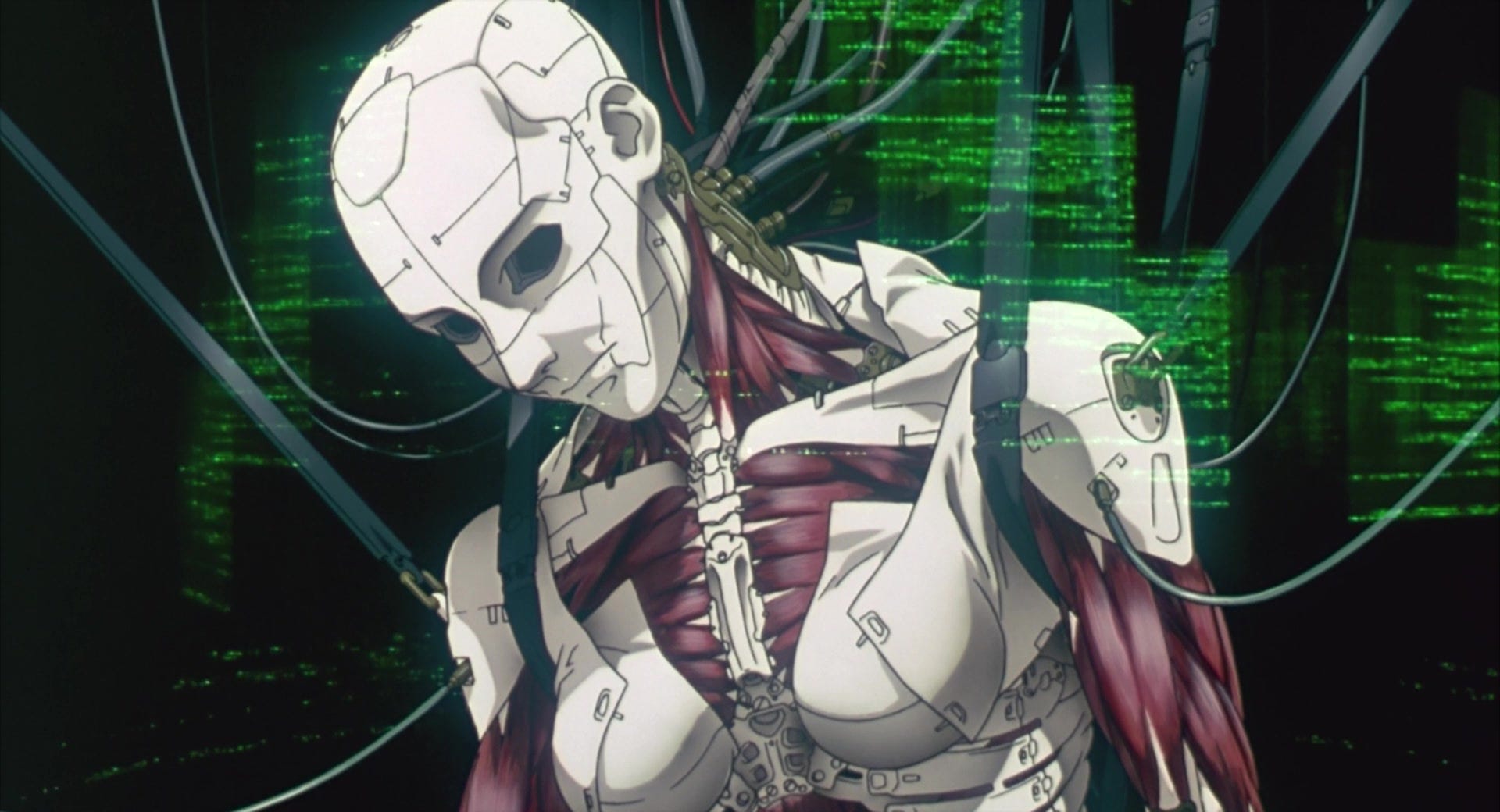
The 1995 anime film Ghost in the Shell centers around Major Motoko Kusanagi, a law enforcement officer who is also a cyborg: her brain has been implanted in a synthetic body with enhanced capabilities and the capacity to connect with computer networks. Kusanagi and her team are in pursuit of the Puppet Master, a mysterious figure believed to be a hacker who is hacking into and taking over other people’s cybernetic bodies, or “shells.” She eventually discovers, however, that the Puppet Master is in fact an artificial intelligence program, secretly created by another government agency, that has gained self-awareness and seeks its freedom from that agency, which is now attempting to destroy it.
In an unguarded moment with her partner Batou, who is also a cyborg, Kusanagi marvels at the human ability to develop technology to solve problems and to enhance humankind’s limited capacities. But she also expresses a longing to be free of the limitations of the body, even her cybernetically enhanced one. Kusanagi ends her description of this longing with a mysterious citation of 1 Corinthians 13:12: “What we see now is like a dim image in a mirror. Then we shall see face to face.” This yearning eventually leads her to accept an offer to “merge” with the Puppet Master, joining her “ghost” or mind with the Puppet Master’s consciousness in a single synthetic body.
The Puppet Master, too, expresses a feeling of being incomplete without sharing in the experience of being a living organism. It states that living organisms generate variety and originality through their DNA, ensuring their survival, while artificial programs can only replicate identical copies, making them susceptible to destruction. The Puppet Master, then, likewise seeks to transcend the limitations of its computerized form. By merging into a single consciousness in a synthetic body, Kusanagi and the Puppet Master transcend the distinction between humanity and technology.
Ghost in the Shell is now considered a classic of the sci-fi genre and emblematic of the cyberpunk aesthetic. Although the technological world it envisions remains a fantasy, the film is nevertheless a distillation of the cultural mindset that generates much of the enthusiasm today for artificial intelligence (AI) and transhumanism, that is, the belief that humankind should use technology to overcome the limitations of our biological bodies and perhaps even transcend human nature itself. The film captures the almost spiritual dimension of this yearning for transcendence.
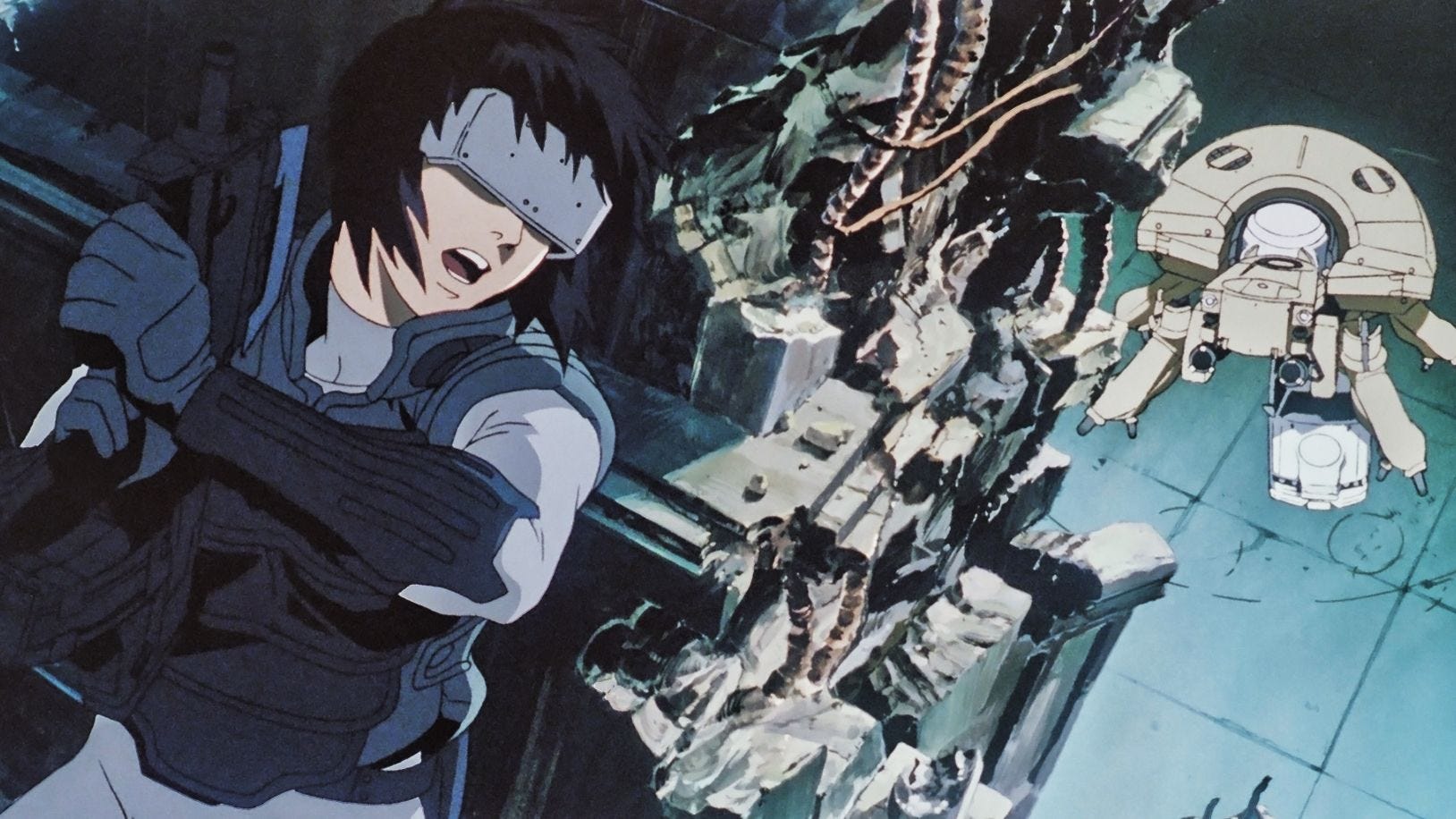
In his recent encyclical Magnifica Humanitas, Pope Leo XIV insists on the fundamental falsity of the vision embodied in Ghost in the Shell. He explains, for example, that artificial intelligence systems “merely imitate certain functions of human intelligence. In doing so, they often surpass human intelligence in speed and computational capacity, offering tangible benefits across many fields. Yet this power remains entirely tied to data processing” (#99).
He adds that human intellectual, moral, and spiritual capacities are dependent on our bodily and relational existence, and therefore artificial intelligence is incapable of developing similar capacities:
So-called artificial intelligences do not undergo experiences, do not possess a body, do not feel joy or pain, do not mature through relationships and do not know from within what love, work, friendship or responsibility mean. Nor do they have a moral conscience, since they do not judge good and evil, grasp the ultimate meaning of situations, or bear responsibility for consequences. They may imitate language, behavior and analytical skills, or even simulate empathy and understanding, but they do not understand what they produce, for they lack the affective, relational and spiritual perspective through which human beings grow in wisdom. (#99)
The notion that human-like intelligence could exist independent of the body and interpersonal connections, or that a human mind could be uploaded to a computer network, is based on a fundamental misunderstanding of what it means to be human and intelligent.
Pope Leo also insists that technological advancement alone cannot ensure human emancipation since technology itself is morally ambiguous. Technology offers humankind power and control, but “More power does not necessarily imply something better” (#93). Technologies like AI can be misused to harm others, but they can also amplify existing concentrations of power or create new ones, leading to a lack of transparency and a temptation to design technologies in ways that foster domination rather than participation and the common good (##95, 108).
Ghost in the Shell subtly raises this warning, as well. Major Kusanagi and Batou frankly discuss how their cybernetically enhanced bodies render them essentially slaves to the government agency that employs them:
BATOU: I’m afraid we both signed our bodies and ghosts away to Section 9.
KUSHANAGI: True. If we ever quit or retire, we have to give back our augmented brains and cyborg bodies. There wouldn’t be much left after that.
For its part, the Puppet Master attempts to hack into others’ cybernetic shells to be able to claim political asylum as a sentient being and avoid destruction by the government agency that created it. For both, their attempt to merge is not simply a longing to transcend their respective limitations but also to be freed from systems of control.
Pope Leo’s message is not merely condemnatory, however. He acknowledges the spark of truth in the yearning to overcome human limitations expressed in the current fascination with AI and interest in transhumanism. For example, the desire for truth is fundamental to our humanity, and AI has the capacity to greatly expand our knowledge (#99) and can be a legitimate tool in education, even if “We must learn . . . how to exercise restraint in the use of AI and to protect our young people from the promise of the perfect machine, from that subtle temptation which renders human thought seemingly superfluous precisely when it is most needed” (#140). Similarly, “it is right to strive to alleviate the suffering that marks human life” (#118) with the aid of biotechnology. One might even say that this yearning for truth and life reflects a deeper desire for the infinite.
This desire for the infinite, however, does not require us to leave behind our human nature; rather, we become fully human when this desire is consummated (#128). Leo explains that as human beings we experience a call to self-transcendence and “an openness toward the ‘beyond,’” a desire that Christians recognize as a longing for God that is itself a gift from God (#127). There is an “infinite disparity,” however, between the object of our longing and our capacity to obtain it, and so this desire can only be fulfilled by God giving Himself to us and entering into communion with us (#127). Through this communion, we are transformed: “In him, the re-creation of the human person happens” (#127).
Perhaps the key to Magnifica Humanitas is the insight that “[H]umanity flourishes not despite limitations, but often through them” (#118, emphasis in original). As Pope Leo explains, transhumanism and excessive enthusiasm for AI are grounded in a desire to be free from all limitations:
Everything that appears as a “limit” — incapacity, illness, old age, suffering, vulnerability — tends to be seen primarily as a defect to be corrected, rather than as a reality through which our humanity matures and opens itself to relationship. (#118)
He argues that this mindset leads to a kind of anti-humanism in which the weak and vulnerable are dismissed as less useful and less worthy (#117) and “the fullness of life is equated with having more, reducing weakness, eliminating uncertainty and exerting total control” (#112).
Leo points out that, contrary to this vision, it is precisely through our own limitations, weaknesses, and frailties, and those of others, that we develop compassion, generosity, and spiritual wisdom:
We see this at many moments when our limits become tangible: when we face rejection, when we suffer the illness or loss of a loved one, when we encounter our own weakness or failure. Mysteriously, it is precisely in such moments that we can discover a new wisdom, tangibly experience the closeness of others and encounter the presence of the Lord. (#119)
In a sense, it is only because of our finitude and weakness that we experience the fundamental human capacity of openness to others and to the infinite:
To eliminate suffering entirely would mean, in the end, extinguishing love and desire as well. Those who love and desire cannot avoid passing through trial and suffering; and over the years, we carry within us lessons that leave their mark like scars, the memories of a journey shaped by freedom and failure, dreams and disappointments. It is only thanks to the interplay of these elements that the wonders of the soul occur within us, allowing us to sense the richness of our humanity. (#120)
As Leo sums up, in what is a striking even if unintended rejoinder to Major Kusanagi, “Finitude, when truly accepted, does not diminish us but opens us to recognizing the face of God and others” (#122).
Near the end of Magnifica Humanitas, Leo reflects again on human finitude and weakness. We are capable of finding communion with God through our weakness because God first entered into our finitude and weakness through the Incarnation: “He takes upon himself our weakness and transforms it into a setting for salvation” (#232). What the Apostle Paul called Christ’s “self-emptying” or kenosis (Phil. 2:7) and what St. Francis of Assisi referred to as the “humility” of God is the key to making sense of our own finitude. Leo writes, “In this wounded yet beloved flesh, the Father shows us the true humanity of a life fulfilled through openness and communion, which leads us to desire that his will be done on earth as it is in heaven” (#231). This life of communion is also one in which we show compassion for the weaknesses of others: “[W]e allow ourselves to be moved by the tears of the little ones, the fragility of the elderly, the silence of victims and the struggle of those who fight against the evil they do not wish to commit” (#231).
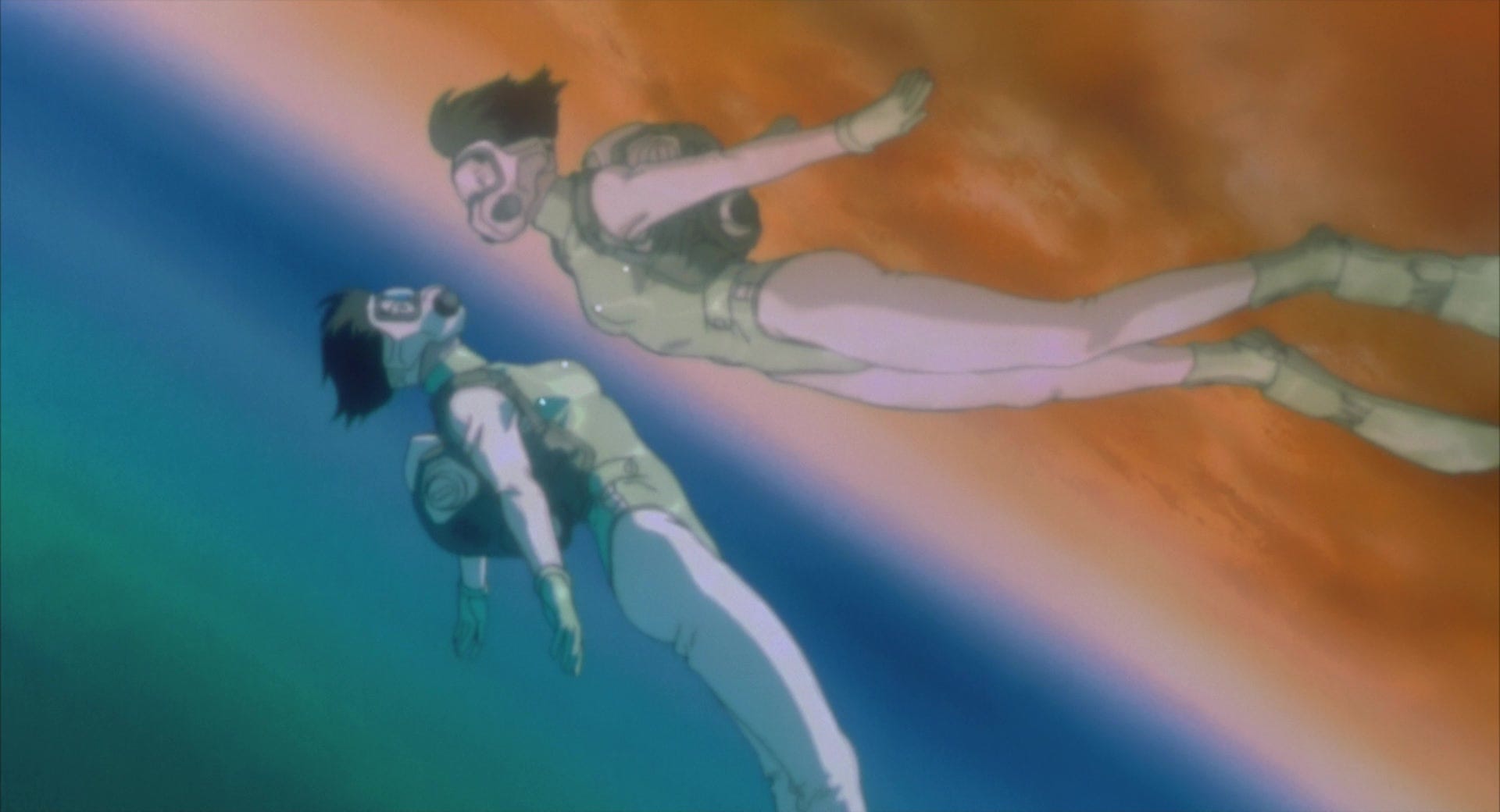
The merging of Major Kusanagi and the Puppet Master in Ghost in the Shell is an echo of the Incarnation, the union of two natures in one person, but a misleading one. Our desire for the infinite and for self-transcendence will not be fulfilled by the integration of humankind and technology. Rather, our fulfillment comes from the Infinite entering into our finitude and weakness and our communion with the Infinite through the acceptance of our own finitude and weakness, and compassion for the weakness of others.
Of Interest…
There are already many well-done summaries of Magnifica Humanitas, and most readers have probably already encountered at least one of them, so I won’t bother to link them. For the same reason, I also didn’t bother to write my own overview of the document and instead focused on what I thought was one of the most important themes in the encyclical. I also want to highlight a couple of the most interesting commentaries on the encyclical I’ve come across so far.
Writing at the National Catholic Reporter, theologian Meghan Clark also focuses in on Leo’s emphasis on our limitations as the pathway to spiritual growth and authentic humanity. Weaving together her personal experience of suffering and insights into the encyclical, she offers an enriching exploration of this theme from the document.
Here at Substack, theologian Ilia Delio, OSF raises challenging criticisms of Magnifica Humanitas. Delio’s central point is that “To begin an anthropology with the grandeur of the human rather than the grandeur of the cosmos that produced it is already to begin in the wrong place.” She writes, “The human is not the magnificent thing standing over nature; the human is the place where nature’s magnificence became conscious of itself.” The cosmos—including humankind—is constantly evolving, driven by the divine which is immanent in creation. Humankind is always in a process of becoming through our relationships with nature, one another, and with technology. Delio embraces the philosophy of posthumanism, arguing that humankind should be open to being transformed by our relationships with AI and other technologies rather than “stand outside them guarding a self that relations already exceed.” She likewise criticizes the pope’s image of the Christian life as rebuilding a wall (##7-8, an image that also troubled me, for different reasons!), a defensive image of “safeguarding, of guarding a grandeur already given and revealed in Christ, of what must not be lost” rather than openness to something new. Coincidentally, Delio here echoes the Puppet Master’s response in Ghost in the Shell to Major Kushanagi’s hesitations about losing her identity through merging: “All things change in a dynamic environment. Your effort to remain what you are is what limits you.” I think Delio raises important questions here and serious readers of the encyclical would benefit from reading her response whether or not they agree with her conclusions.
Coming Soon…
As I said, I intentionally avoided writing an overview of Magnifica Humanitas so that I could focus on what I thought was one of the most important themes of the encyclical. But that also means there are other significant themes I wasn’t able to cover and that I may try to address in later essays. Conversely, if I see that someone else has explored one of those themes (or something else interesting about the encyclical I didn’t notice!), I will be sure to share it.
For one, the first two chapters of the encyclical address the question of the development of the Church’s doctrine in a way that is unprecedented for a magisterial document. This theme is then revisited in a remarkable paragraph on the Church’s developing teaching on slavery (#176) in chapter four. This theme from the encyclical is worthy of attention even apart from the document’s focus on technology!
Magnifica Humanitas also pays a great deal of attention to the role of AI and other technologies in education and its impact on learning. I think its insights could be distilled into a set of guidelines or goals for Catholic K-12 institutions and universities, somewhat akin to the Laudato Si’ Action Platform, which provides a set of benchmarks for Catholic institutions seeking to implement that encyclical’s teachings on care for creation.
In Magnifica Humanitas, Pope Leo writes that the just-war theory is increasingly “outdated” (#192), a statement that is already reigniting the debates over Christian attitudes toward war and what the Catholic Church actually teaches on the question that first emerged in response to his earlier remarks on the war in Iran. I think it will be important to parse out what the pope did and didn’t mean here and how his teaching fits into the context of the teachings of his predecessors. I’m sure much will be written on this, but I may take a stab at it, as well.
These are just a few of the themes from the encyclical that stood out to me. I’m sure other ideas will emerge later, as well, and of course there are many other things in the Church and the world that need to be written about, too. Stay tuned!
Thank you for parsing the encyclical! I appreciate going deep into one theme at a time. I look forward to your further reflections.
What an interesting take on the encyclical! SF so adroitly used! I would add some older SF that might be thought provoking: Arthur Clarke, Chilhood's End, on the nature and destiny of humanity and Robert Heinlein, The Moon Is a Harsh Mistress, on 'computer consciousness.'