A Medieval Argument on God, Causality, and Sin
The 14th-Century Franciscan Francis of Meyronnes

We “live, and move, and have our being” in God (Acts 17:28), as the Apostle Paul taught the Athenians, and this has led many theologians over the ages to conclude that nothing happens in the cosmos without God in some sense sharing in causing it. This is even true of our free choices—in the technical language of medieval scholastic philosophy, God is the primary cause of our actions while we are the secondary cause. This conclusion reflects the biblical notion that nothing happens outside of God’s providence: “Unless the Lord build the house, they labor in vain who build” (Ps. 127:1). Of course, this raises the tricky question of how this divine causality can be reconciled with our free will, a question theologians have answered in a variety of ways.
It also raises the question of whether God causes or wills our sins. After all, if nothing happens without God’s concurrence, then how is it possible for us to sin if God does not in some sense will it? Although we naturally wonder about whether God causes evil and suffering in the world, perhaps to bring some greater good from it, I think most believers recoil at the thought that God causes our sin. The Catholic tradition has largely followed St. Augustine on this question. Augustine argues that God is by no means the cause of our sin, but rather the human will is sin’s “deficient cause” (a play on Aristotle’s term “efficient cause”). What he means is that sin comes about as a result of a defect in our will, our failure to cooperate with God’s will. Later Catholic theologians developed various elaborations of this argument.
The fourteenth-century Franciscan theologian Francis of Meyronnes, however, reached the startling conclusion that God does in fact cause our sins, although He Himself does not sin or incur guilt by doing so. As he writes in his Commentary on the Sentences: “It does not seem incongruous that God is the universal cause of sin, and yet that He does not sin” (II.43-44.7). I recently discovered Meyronnes’s argument while researching my ongoing project on the doctrine of predestination in the Scotist tradition. I was shocked—not least because, despite being identified by later generations as “the Prince of the Scotists,” he is explicitly disagreeing with John Duns Scotus here—but likewise intrigued by how he could reach such a problematic conclusion. It turns out that, despite their unacceptable end point, Meyronnes’s arguments are formidable.
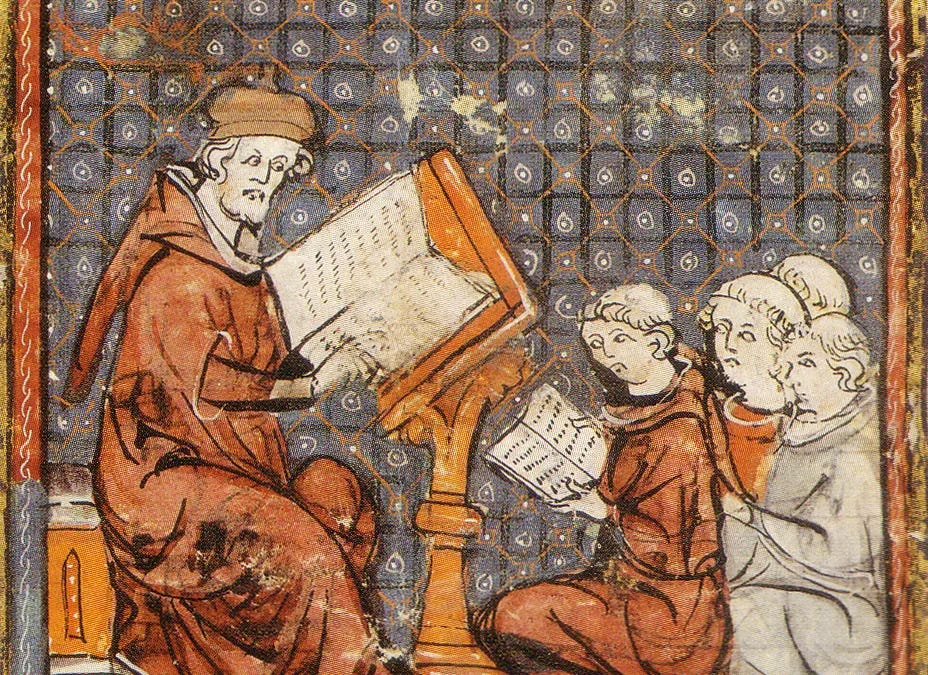
Before getting to those arguments, an introduction to Meyronnes will be helpful. Francis of Meyronnes was born in Provence, in southern France, sometime in the 1280s and was a student of Scotus at the University of Paris at some point between 1304 and 1307. Being a pupil of a theology lecturer at Paris did not at the time imply that the student was necessarily a follower of the teacher—after all, the students had to attend the lectures of whoever was lecturing on the Sentences of Peter Lombard at the time!—but Meyronnes was deeply influenced by Scotus and largely follows him in his own Commentary on the Sentences, which he produced in 1320-21, where he refers to Scotus as “doctor noster” (“our teacher”, III.17-22.4). In 1324, he was elected Franciscan provincial general for the Provence region, which coincidentally put him in close proximity to Avignon, where the popes had taken up residency since 1309. He advised Pope John XXII on the question of Franciscan poverty and took part in the investigation of his more well-known Franciscan brother William of Ockham. Meyronnes died sometime between 1326 and 1328.
In the early fourteenth century, the question of divine causality in Creation was a hot topic among theologians, and this debate was the milieu in which Meyronnes developed his arguments. The Dominican Durand of Saint-Pourçain and the Franciscans Peter John Olivi and Peter Auriol had taken the radical position that, while God provides created beings with the power to act and sustains those creatures in being, God does not concur in causing the actions of created beings. That applies, they argued, to both non-human creatures and human beings. This theory provides an elegant solution to the problem of whether God causes sin because it proposes that, although God provides us the capacity to choose sin, God in no way causes our actions, let alone our sins. But—as these theologians’ Thomist and Scotist opponents never ceased to point out—the theory seems to suggest that human choices are outside of God’s providence and calls into question God’s omnipotence (and, according to the Scotists in particular, God’s omniscience, as well, since in their view God knows things by willing them).